The effectiveness of the Federal Integrity Commission in combating corruption in Iraq after 2020
DOI:
https://doi.org/10.64184/ajlps.V3.I3.Y2026.p.368-392.393Keywords:
Integrity Commission, corruption, state, Iraq.Abstract
The problem of corruption is one of the most prominent challenges that Iraq has faced since 2003, and its negative effects on development and political and economic stability have increased. Therefore, the role of the Federal Integrity Commission has emerged as the official institution concerned with preventing corruption, investigating its cases, and promoting the principles of transparency and accountability. After 2020, the Commission witnessed remarkable transformations in its working mechanisms as a result of popular pressure and government reforms. The Iraqi government moved towards tightening anti-corruption measures and recovering public funds. The Commission worked to expand the scope of investigations into cases of bribery, embezzlement, and abuse of power, as well as cooperating with judicial and oversight bodies to prosecute the accused and recover funds smuggled out of the country. The Commission also adopted systems for disclosing financial assets, in addition to strengthening international cooperation with organizations concerned with combating corruption in order to develop oversight and prevention tools.
References
Sources and references
First/ sources :
1/Laws
1. The Integrity and Illicit Enrichment Commission Law of 2011, as amended.
Second/ references:
1/Books
1. Hussein Alawi Nasser Al-Ziyadi, Financial and Administrative Corruption in Iraq: A Geographical-Political Perspective, Al-Rafidain Center for Dialogue, Najaf, 2023.
2. Ahmed Sami Al-Maamouri, From Petty Corruption to Grand Corruption, in the book (Iraq: Two Burning Decades of Crisis Proliferation... Solutions Remain Impossible), Volume 4, Al-Rafidain Center for Dialogue, Najaf, 2023.
3. Firas Al-Bayati, Democratic Transition in Iraq After April 9, 2003, Al-Aref Publications, Najaf, 2013.
2/ Theses:
1. Ali Salem Jabbar, Institutional Organization for Combating Corruption in Iraqi Law (The Integrity Commission as a Model), Unpublished Master's Thesis, Faculty of Law, Islamic University of Lebanon, 2022.
3/ Research and Studies:
1. Taghreed Sami Ibrahim, The Efforts of the Integrity Commission in Combating Corruption in Iraq, Dijlah Journal of Humanities, Dijlah University, Baghdad, Volume 8. Issue 1, 2025.
2. George Labaki and Baraa Abdul-Hakim Khalil Al-Samarrai, The Role of Iraqi Laws and Institutions in Combating Corruption, Al-Shara’i Journal for Legal, Administrative, and Political Studies, Al-Shara’i Center for Developing Legal and Administrative Skills, Iraq, Volume 4, Issue 4, 2024.
3. Sami Alawiya and Faisal Ghazi Muhammad, The Impact of Modernity from a Legal Perspective – The Federal Integrity Commission as a Model, Al-Muhaqqiq Al-Hilli Journal for Legal and Political Sciences, University of Babylon, Babylon, Volume 21, Issue 1, 2025.
4. Sahar Jabbar Yaqoub, The Authorities Competent in Combating the Phenomenon of Corruption in Iraq, Al-Kufa Journal for Legal and Political Sciences, University of Kufa, Najaf, Volume 8, Issue 26, 2016.
5. Sahar Mohsen Aboud, The Role of Independent Oversight Bodies in Combating Corruption / Selected Models, Al-Salam University Journal, Al-Salam University College, Baghdad, Volume 2, Issue 17, 2024.
6. Ali Mahdi Kadhim, Corruption in Iraq After 2003 and Its Repercussions on National Sovereignty, Political and International Journal, Al-Mustansiriya University, Baghdad, Issue 63, 2025.
7. Alia Hussein Khalaf and Diaa Hussein Saud, Combating Corruption: A Strategic Option for Achieving Economic Development in Iraq, Al-Rafidain University College of Science Journal, Al-Rafidain University College, Iraq, Issue 42, 2018.
8. Imad Abdul Latif Salem, Corruption in Iraq: From Structure to Phenomenon – An Attempt to Break the Vicious Cycle of Sustainability (1974-2015), Al-Ghari Journal of Economic and Administrative Sciences, University of Kufa, Najaf, Volume 14, Issue 3, 2017.
9. Nazim Nawaf Ibrahim, The Phenomenon of Corruption in Iraq After 2003: A Study of (Causes, Effects, and Solutions), Political and International Journal, Al-Mustansiriya University, Baghdad, Issue 30, 2016.
10. Nasreen Ahmed Abdullah Al-Jaf, Administrative and Financial Corruption in Iraq (Causes and Solutions), Babylon Center for Humanistic Studies Journal, University of Babylon. Babylon, Volume 15, Issue 3, 2025.
4/ Reports:
1. Republic of Iraq, Federal Integrity Commission, Annual Report for 2020.
2. Republic of Iraq, Federal Integrity Commission, Annual Report for 2021.
3. Republic of Iraq, Federal Integrity Commission, Annual Report for 2022.
4. Republic of Iraq, Federal Integrity Commission, Annual Report for 2023.
5. Republic of Iraq, Federal Integrity Commission, Annual Report for 2024.
Downloads
Published
Issue
Section
License
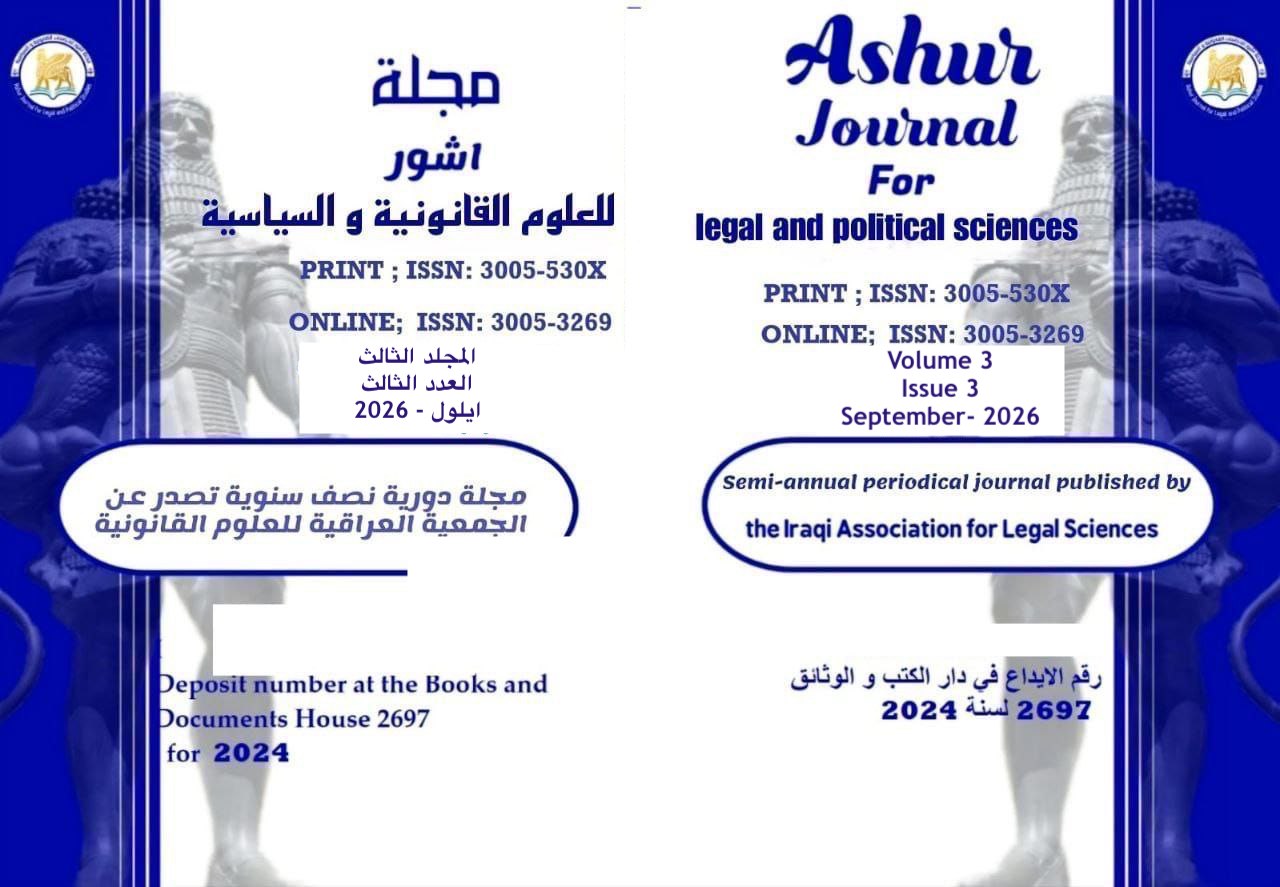
Copyright (c) 2026 Ashur Journal of Legal and Political Sciences is issued by the Iraqi Association of Legal Sciences

This work is licensed under a Creative Commons Attribution 4.0 International License.
The authors retain Full copyright of their published article
Ashur Journal of Legal and Political Sciences applies the Creative Commons Attribution 4.0 International (CC BY 4.0) License to articles and other works we publish. If you submit your paper for publication by AJLPS, you agree to have the CC BY 4.0 license applied to your work.
Articles can be read and shared for under the following conditions:
BY: Attribution must be given to the original source (Attribution)
Full details available at
https://creativecommons.org/licenses/by/4.0/